ACCIDENTALLY AN AUTEUR
3
/
1
22nd July 2026
Since working in theatre, I have always had a distrust of directors who approach a play with a big idea – ‘The Tempest is about control, Prospero coercively controls the narrative and characters, and so I will set my production in a circus ring with Prospero as ringmaster.’
(Apologies to anyone whose big idea I may have just inadvertently parodied. I believe I have just made this up. But I probably haven’t.)
(Alternatively, if you want to steal this big idea, please, go ahead, do so. I think it’s awful.)
Big ideas such as these feel reductive – a good play like The Tempest is about so many things simultaneously, including control – and I often get the sense that by imposing a big idea on a show the director is trying to show off their cleverness. This distrust is born out of a lifelong dislike of pretentiousness (and do please pick me up when I am being pretentious!) and a passionate belief in the importance of telling the story clearly to everyone. My awful circus production of The Tempest presupposes a knowledge of the play – if you don’t come to the theatre having read it, thought about it, and seen other productions, then the circus setting does nothing to elucidate what Shakespeare has written.
We are simultaneously demonstrating a problem and exemplifying the solution.
This is not to say that there is no conceptual framework underpinning what I do; it’s just that it emerges slowly, in response to exploring the best ways to share the story with the audience.
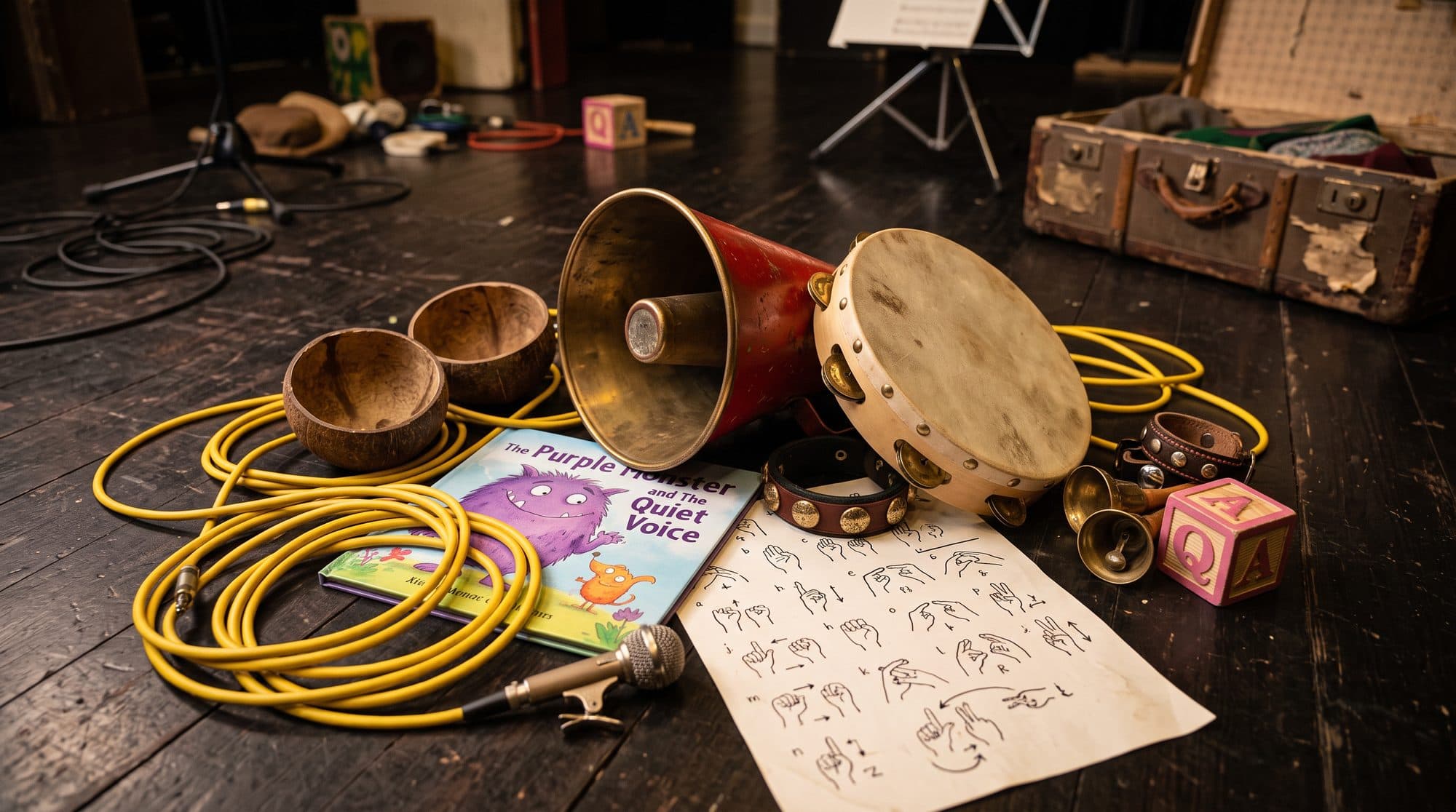
I realised this last week, in a three day workshop exploring how Roustabout are going to bring David McKee’s Not Now, Bernard to the stage. For those of you not familiar with the book, it tells the story of Bernard who is ignored by his parents and then eaten by a monster. In the rehearsal room we had our three cast members, a musician who was also responsible for live Foley, a mime specialist, a Makaton specialist, and the picture book. The big questions were ‘Can all these approaches to storytelling work together?’ and ‘Do two different visual sign systems, mime and Makaton, get in each other’s way?’ At the end of the three days we were joined by the set and costume designer, the lighting designer, the production manager, and our producer for a production meeting, and I was asked what we had learned.
I found myself saying, ‘We have stuffed a story about the perils of not communicating with as many different forms of communication as possible. Whilst the characters ignore each other, our performers are in a state of hyper-communication with each other and the audience. We are simultaneously demonstrating a problem and exemplifying the solution.’ I hadn’t realised this until it came to articulating it. There is a big idea in this show after all, but it had come from within, from finding how to tell the story, and it had emerged organically from the collaboration of so many different creative imaginations. I think I’m okay with this...
Read More
Thursday 30th July 2026
The first being a reminder that many people don’t use the term R&D in their work, so when you’re talking to your friends just check that they know what it stands for.
25th March 2026
Last night I ran a workshop for Bristol A Cappella, a champion mixed barber shop chorus. They are conscious that the world in which they move is pushing towards greater theatricality in its performance, and wanted some support in helping their members act through the songs they sing. At the end of the session, one of the members showed me a big red cardboard sign that they have, emblazoned with the words TOO MUCH. They use this if the choir over act. Apparently it is rarely required.